
Building a Privacy-First WhatsApp Ordering System for a Personalised Gifts Business
In today’s digital marketplace, customers expect convenience without compromising their privacy. For personalised gifts businesses, WhatsApp has become one of the most effective channels for taking orders, answering customer queries, sharing product catalogs, and providing real-time support.
However, handling customer names, addresses, photos, custom messages, payment details, and delivery information requires a strong commitment to privacy and data protection.
A privacy-first WhatsApp ordering system helps businesses build trust while streamlining operations. Instead of collecting unnecessary customer information, businesses can focus on secure communication, transparent policies, and efficient order management.
At Ratnam Digital, we believe customer trust is the foundation of long-term business success. This guide explains how to create a secure, customer-friendly WhatsApp ordering system for your personalised gifts business.
Why WhatsApp Is Ideal for Personalised Gift Businesses
Millions of people already use WhatsApp daily, making it a familiar and trusted communication platform.
Benefits include:
- Instant communication
- Fast order confirmations
- Easy image sharing
- Voice message support
- Real-time customer assistance
- Location sharing
- Catalog browsing
- Quick payment coordination
Customers ordering customized gifts often need discussions about colors, names, photos, fonts, sizes, and special instructions. WhatsApp makes these conversations simple.
What Does “Privacy-First” Mean?
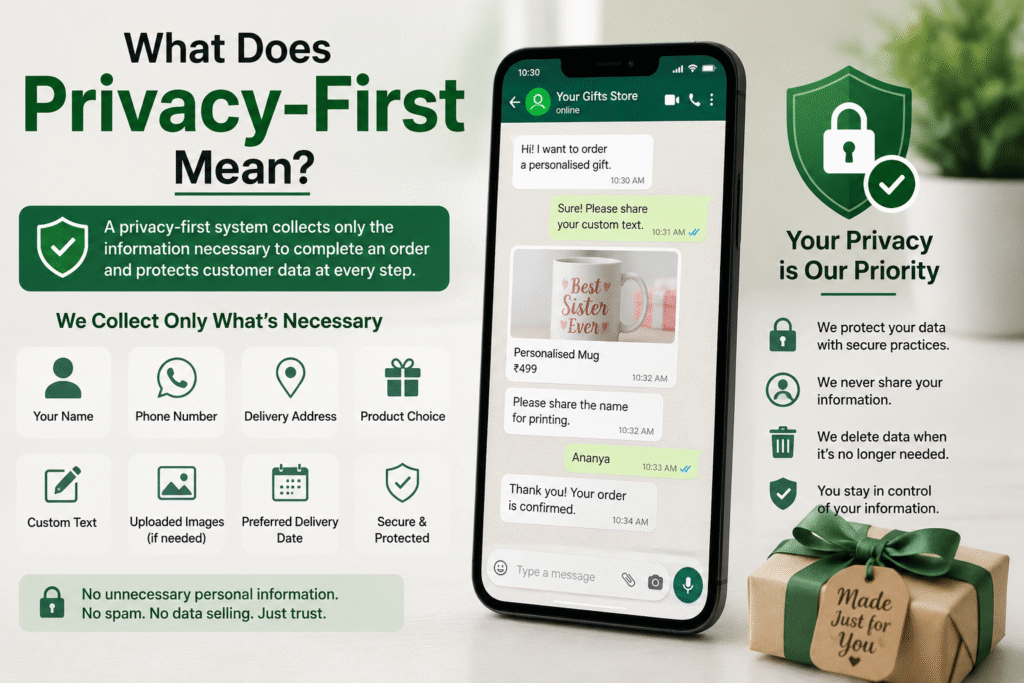
A privacy-first system collects only the information necessary to complete an order.
Instead of asking customers for excessive personal details, businesses should gather only what is required, such as:
- Customer name
- Delivery address
- Phone number
- Product choice
- Custom text
- Uploaded images (if needed)
- Preferred delivery date
Avoid requesting unnecessary personal information.
Benefits of a Privacy-First Ordering System
A secure ordering process benefits both customers and businesses.
Advantages include:
- Increased customer trust
- Higher conversion rates
- Better customer loyalty
- Reduced security risks
- Easier compliance with privacy regulations
- Professional business image
- Improved brand reputation
Customers are more likely to place repeat orders when they know their information is handled responsibly.
Essential Components of a WhatsApp Ordering System
Business WhatsApp Account
You should use WhatsApp Business instead of your personal account.
Features include:
- Business profile
- Working hours
- Greeting messages
- Quick replies
- Product catalog
- Labels
- Automated responses
Product Catalog
Organize products into categories:
- Photo Frames
- Mugs
- Cushions
- T-Shirts
- Wooden Gifts
- Acrylic Gifts
- Name Plates
- LED Frames
- Keychains
- Corporate Gifts
Each product should include:
- Images
- Price
- Description
- Available sizes
- Delivery time
Automated Welcome Message
A welcome message helps customers understand the ordering process.
Example:
Welcome to our personalised gifts store! 🎁
Please browse our catalog or tell us what you’re looking for.
We’ll help you customize your perfect gift.
Quick Reply Templates
Save time with predefined replies.
Examples:
- Pricing information
- Shipping details
- Payment instructions
- Delivery timelines
- Customization options
- Image upload instructions
Customer Ordering Workflow
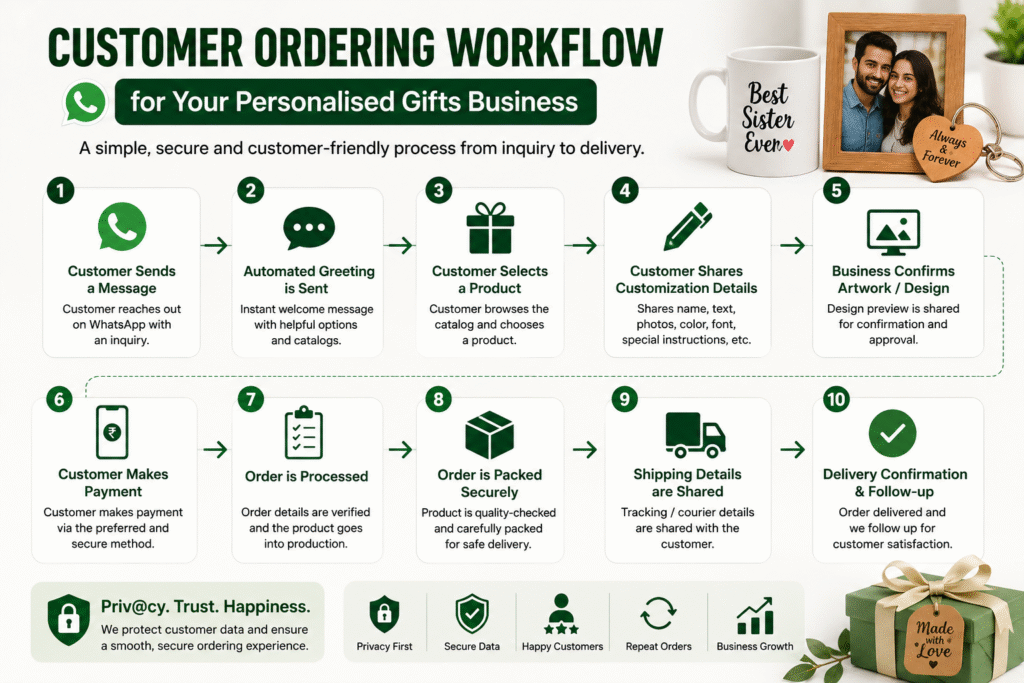
A simple ordering process improves customer satisfaction.
Typical workflow:
- Customer sends a message.
- Automated greeting is sent.
- Customer selects a product.
- Customer shares customization details.
- Business confirms artwork.
- Customer makes payment.
- Order is processed.
- Shipping details are shared.
- Delivery confirmation is sent.
- Customer receives follow-up support.
Secure Handling of Customer Images
Personalised gifts often require customer photos.
Best practices include:
- Accept images only when necessary.
- Use secure devices.
- Delete images after order completion if no longer needed.
- Never reuse customer images without permission.
- Avoid sharing customer photos publicly without consent.
Protecting Customer Information
Customer information should be accessible only to authorized staff.
Recommended practices:
- Use strong passwords.
- Enable two-factor authentication.
- Restrict device access.
- Regularly update software.
- Lock inactive devices.
- Use encrypted backups where appropriate.
Transparency Builds Trust
Clearly explain:
- What information you collect
- Why you collect it
- How long you keep it
- Who can access it
- How customers can request deletion
Customers appreciate honesty.
Using WhatsApp Labels for Better Organization
WhatsApp Business Labels can improve workflow.
Example labels:
- New Inquiry
- Payment Pending
- Design Approval
- Printing
- Ready to Ship
- Shipped
- Delivered
- Repeat Customer
This helps staff manage orders efficiently.
Order Confirmation Checklist
Before production, confirm:
- Customer name
- Phone number
- Delivery address
- Product selected
- Quantity
- Personalized text
- Uploaded images
- Color preference
- Font selection
- Delivery date
This minimizes errors.
Payment Security Best Practices
Never ask customers to share sensitive financial information in chat.
Instead:
- Share official payment methods.
- Confirm payment after receipt.
- Send digital invoices where possible.
- Maintain transaction records securely.
Managing Customer Expectations
Keep customers informed throughout the order journey.
Provide updates for:
- Order received
- Design completed
- Approval required
- Printing started
- Packed
- Shipped
- Delivered
Regular communication reduces customer anxiety.
Customer Consent for Marketing
Do not automatically add customers to promotional lists.
Instead:
Ask permission before sending:
- Festival offers
- Birthday discounts
- New product launches
- Seasonal collections
- Loyalty rewards
Respecting customer preferences strengthens your brand.
Integrating Automation Without Losing the Human Touch
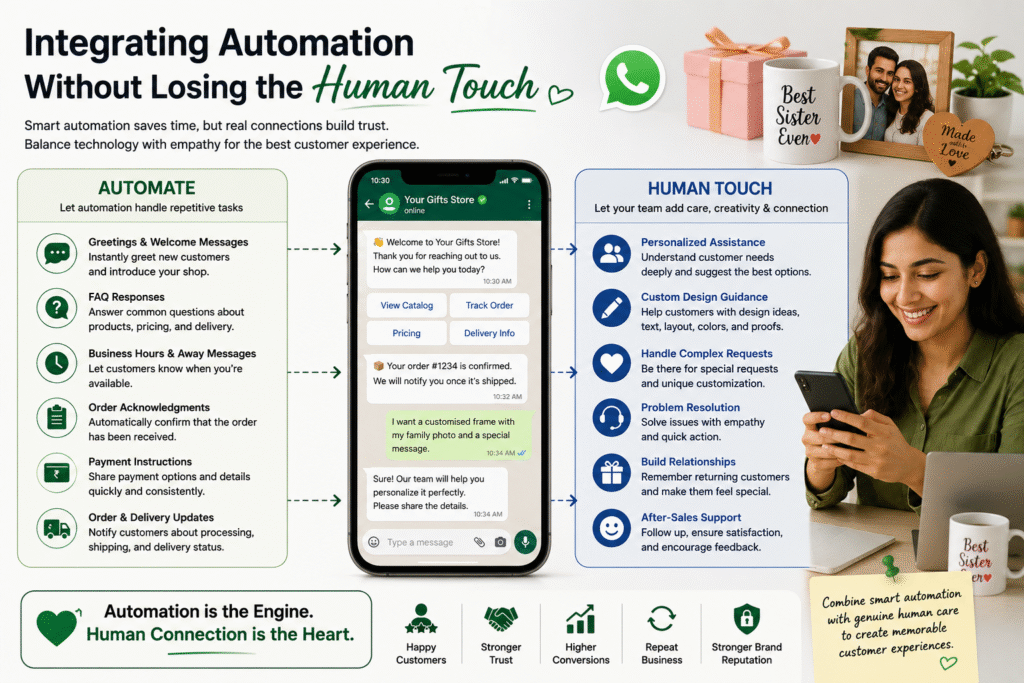
Automation saves time, but customers still value personal interaction.
Automate:
- Greetings
- FAQs
- Business hours
- Order acknowledgments
- Payment instructions
Keep human support for:
- Design discussions
- Custom requests
- Complaints
- Complex orders
Common Mistakes to Avoid
Avoid these mistakes:
- Collecting unnecessary customer data
- Delayed responses
- Poor order tracking
- Sending excessive promotional messages
- Ignoring privacy concerns
- Using personal WhatsApp accounts for business
- Losing customer images
- Sharing customer conversations
Measuring Success
Track important metrics such as:
- Response time
- Order completion rate
- Customer satisfaction
- Repeat purchase rate
- Average order value
- Delivery accuracy
- Customer referrals
These insights help improve service quality.
Future Trends in WhatsApp Commerce
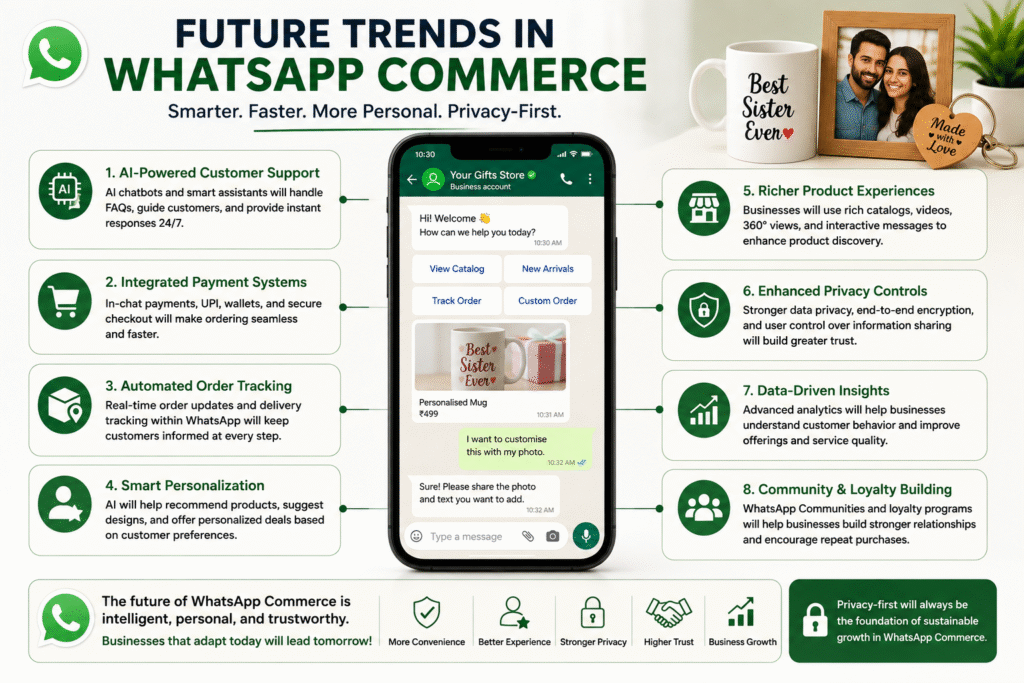
The future of WhatsApp ordering includes:
- AI-powered customer support
- Automated order tracking
- Integrated payment systems
- Smart product recommendations
- Personalized shopping experiences
- Rich media catalogs
- Enhanced privacy controls
Businesses that adopt these innovations while prioritizing customer privacy will remain competitive.
Conclusion
A privacy-first WhatsApp ordering system is more than a technology upgrade—it is a commitment to customer trust. By collecting only the necessary information, protecting customer data, communicating transparently, and combining automation with personalized service, personalised gifts businesses can deliver a seamless and secure ordering experience.
Whether you’re a small home-based gift creator or an established personalized gifting brand, implementing these privacy-focused practices will help you build lasting customer relationships, improve operational efficiency, and strengthen your reputation in an increasingly competitive market.
At Ratnam Digital, we help businesses create customer-centric digital experiences that prioritize both convenience and privacy. Investing in a secure WhatsApp ordering system today can lead to higher customer satisfaction, repeat business, and long-term growth.
Frequently Asked Questions (FAQs)
1. What is a privacy-first WhatsApp ordering system?
It is an ordering process that collects only essential customer information while protecting personal data and maintaining transparency.
2. Why should personalised gift businesses use WhatsApp?
WhatsApp enables quick communication, easy customization discussions, image sharing, and real-time customer support.
3. Is WhatsApp Business better than personal WhatsApp?
Yes. WhatsApp Business offers catalogs, labels, quick replies, greeting messages, and automation features.
4. What customer information should be collected?
Only necessary details such as name, phone number, delivery address, selected product, customization requests, and payment confirmation.
5. Should businesses store customer images permanently?
No. Images should only be retained as long as necessary to complete the order or if the customer has explicitly agreed to future use.
6. How can businesses protect customer data?
Use strong passwords, enable two-factor authentication, limit staff access, and secure business devices.
7. Can WhatsApp automate customer responses?
Yes. Greeting messages, FAQs, business hours, and quick replies can be automated.
8. How do labels improve order management?
Labels help categorize orders by status, making it easier to track progress and respond efficiently.
9. Is customer consent required for marketing messages?
Yes. Customers should opt in before receiving promotional communications.
10. What should an order confirmation include?
Product details, customization instructions, quantity, delivery address, payment status, and expected delivery date.
11. How can businesses avoid customization errors?
Confirm all personalization details with the customer before production begins.
12. Is it safe to discuss payments on WhatsApp?
Businesses should share official payment methods but avoid requesting sensitive financial information through chat.
13. How often should customers receive order updates?
Provide updates at key milestones such as order confirmation, design approval, production, shipping, and delivery.
14. What are quick replies in WhatsApp Business?
Predefined responses that help businesses answer common questions quickly and consistently.
15. Why is transparency important?
It builds customer trust by explaining how personal information is collected, used, and protected.
16. Can small businesses implement a privacy-first system?
Absolutely. Even small businesses can adopt privacy-focused practices using WhatsApp Business and simple security measures.
17. How does a privacy-first approach improve customer loyalty?
Customers are more likely to return when they feel their personal information is respected and protected.
18. What metrics should businesses track?
Monitor response time, repeat purchases, customer satisfaction, delivery accuracy, and conversion rates.
19. Can automation replace human support?
No. Automation should handle routine tasks, while human interaction remains essential for custom orders and problem resolution.
20. How can Ratnam Digital help?
Ratnam Digital assists businesses in designing secure, efficient, and customer-friendly WhatsApp ordering systems that enhance trust, streamline operations, and support long-term business growth.