
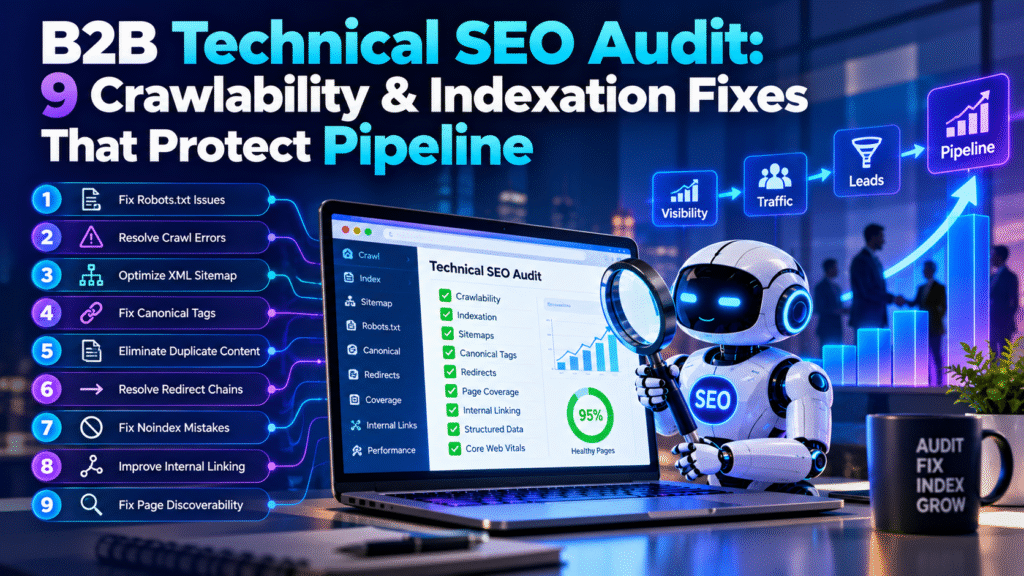
For high-ticket B2B service firms, SaaS platforms, and specialized consultancies, organic search is often the primary source of qualified inbound discovery. Yet, many executive teams watch their organic traffic plateau or steadily decline despite publishing detailed case studies and thought leadership. When marketing leaders examine why their rankings stall, the root cause is rarely content depth—it is technical friction.
When search engine bots like Googlebot struggle to discover, render, or prioritize your core service URLs, your entire organic pipeline suffers. A single misplaced canonical tag or accidental blocking in robots.txt can silently wipe away months of organic acquisition. In this comprehensive guide, we unpack the 9 mission-critical technical SEO fixes that protect your B2B crawl budget, ensure clean indexation, and drive sustainable inbound revenue.
Table of Contents
- 1. Audit and Purge Canonical Tag Loops
- 2. Eliminate Rogue “noindex” Directives on Money Pages
- 3. Resolve Trailing Slash and Protocol Inconsistencies
- 4. Streamline XML Sitemaps and Remove Deadweight URLs
- 5. Optimize Crawl Budget by Pruning Faceted Navigations
- 6. Reclaim Lost Authority from Orphan Service Pages
- 7. Accelerate Server Response Times (TTFB) and Core Web Vitals
- 8. Implement Clear JSON-LD Structured Data Hierarchy
- 9. Prepare Technical Architecture for Generative AI & AEO
- Frequently Asked Questions (FAQ)
1. Audit and Purge Canonical Tag Loops
Self-referential canonical tags tell search engines which URL represents the authoritative version of a page. However, during CMS migrations, staging pushes, or template changes, canonical URLs frequently point to outdated HTTP versions, non-slash variants, or redirecting pages. When Googlebot encounters contradictory canonical instructions, it ignores the tag entirely and selects an arbitrary URL, often splitting ranking power across duplicate endpoints.
2. Eliminate Rogue “noindex” Directives on Money Pages
One of the most catastrophic yet surprisingly common technical blunders occurs when staging directives carry over to production. Development teams frequently apply <meta name="robots" content="noindex, nofollow"> to pre-launch pages. If landing pages or service hubs launch with lingering tags, search engines will purge them from search results within days. Regular automated header scans prevent these silent revenue leaks.
3. Resolve Trailing Slash and Protocol Inconsistencies
To a search crawler, https://yoursite.com/service and https://yoursite.com/service/ are treated as two distinct URLs serving identical content. If internal navigation links use inconsistent URL formats, you force search crawlers through 301 redirects on every click. Enforcing a single strict standard across all internal links, sitemaps, and server configurations consolidates PageRank and reduces server latency.
4. Streamline XML Sitemaps and Remove Deadweight URLs
Your XML sitemap should serve as an authoritative index of indexable, high-priority landing pages. Submitting sitemaps clogged with 404 errors, 301 redirects, password-protected resources, or pagination archives dilutes crawl efficiency. Keep your sitemaps clean, dynamic, and strictly limited to canonical 200-OK pages that deserve indexation.
5. Optimize Crawl Budget by Pruning Faceted Navigations
While crawl budget is often considered an enterprise concern, poorly configured faceted searches, sorting parameters, and session IDs can cause severe crawler traps on smaller websites. Restrict non-essential URL parameters in your robots.txt file and ensure Googlebot focuses computing resources exclusively on revenue-generating pages.
6. Reclaim Lost Authority from Orphan Service Pages
Orphan pages are URLs that exist on your server but have zero incoming internal links from other pages on your website. Because search crawlers discover pages by following hyperlinks, orphan landing pages receive little to no crawl attention and suffer from weak domain authority distribution. Establishing contextual in-content links from high-authority blog posts directly to commercial service pages ensures optimal indexation.
7. Accelerate Server Response Times (TTFB) and Core Web Vitals
Technical performance directly influences crawl frequency. If your server takes over 800 milliseconds to respond with initial HTML (Time to First Byte), crawlers will throttle back the number of pages they inspect per session. Implementing server-level caching (such as LiteSpeed Cache), preconnecting critical fonts, and delivering optimized modern images significantly improves user retention and crawl efficiency.
8. Implement Clear JSON-LD Structured Data Hierarchy
Schema markup removes ambiguity for search algorithms. Rather than relying on search engines to guess your company’s offerings, implementing structured ProfessionalService and Service JSON-LD schemas explicitly identifies your services, founder credentials, pricing tiers, and geographic coverage in a machine-readable format.
9. Prepare Technical Architecture for Generative AI & AEO
As modern search habits evolve toward generative discovery platforms like ChatGPT, Perplexity, and Google AI Overviews, technical clean-up becomes even more vital. AI engines rely on structured heading hierarchies, crawlable text blocks, and authoritative citations to extract answers. A technically pristine site provides the semantic clarity required for AI engines to quote your brand as an industry authority.
Frequently Asked Questions (FAQ)
How often should a B2B company perform a technical SEO audit?
High-growth B2B firms should conduct a comprehensive technical SEO crawl audit at least quarterly, or immediately following any significant CMS update, website redesign, or domain migration.
What is the difference between crawlability and indexability?
Crawlability refers to a search engine’s ability to access and navigate your website’s pages. Indexability refers to a search engine’s ability to analyze and store that content in its search database so it can appear for relevant search queries.
Can technical SEO alone improve keyword rankings?
Technical SEO fixes the foundation. While eliminating indexation roadblocks can rapidly restore suppressed rankings, sustained organic dominance requires combining technical excellence with authoritative content and strategic internal linking.
Related Growth Playbooks & Strategic Resources
Protect Your Inbound Pipeline with a Technical SEO Audit
Eliminate crawl traps, canonical loops, and indexation leaks. Partner with Ratnam Digital to ensure enterprise search engines and AI answer engines index every high-value page.
Explore Technical SEO Services Request a Strategy & Growth Audit