
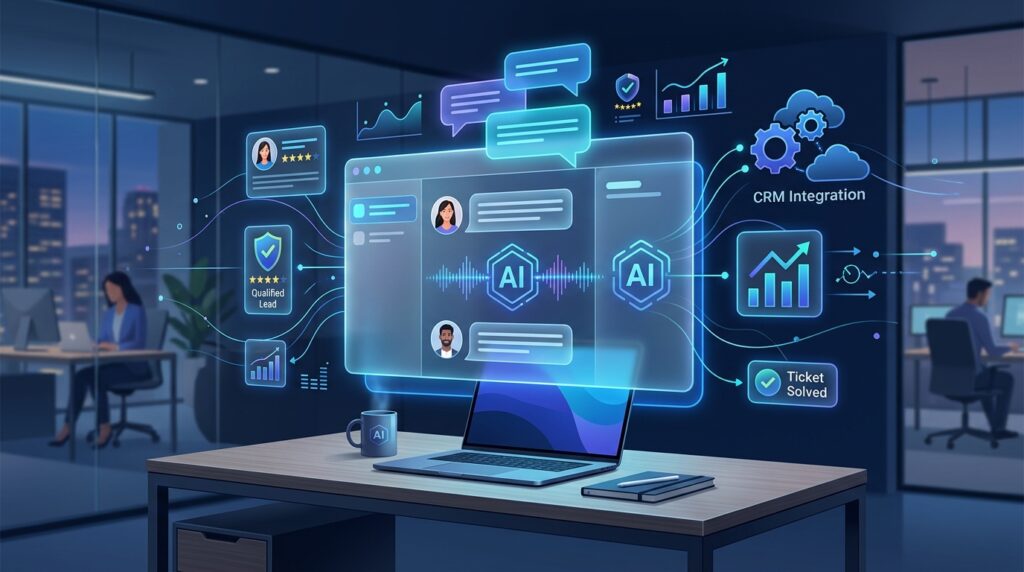
Every small business owner knows the sinking feeling of a missed customer inquiry.
A high-intent buyer visits your website at 8:45 PM, ready to schedule a discovery call or request a project quote. They have two straightforward questions about your pricing tiers and turnaround time. But because your team clocked out at 5:30 PM, their message sits in an unmonitored inbox. By 9:15 PM, that prospect has moved down Google search results, contacted a competitor who responded instantly, and disappeared from your pipeline forever.
Speed to lead is no longer a luxury; it is the baseline of modern commerce. Industry response-time benchmarks consistently show that businesses responding to inbound leads within five minutes are 21 times more likely to qualify that opportunity than those waiting thirty minutes.
Yet, lean small businesses cannot afford a 24/7 shifts-based customer support team.
This is where modern conversational artificial intelligence changes the equation. Unlike the clunky, infuriating chatbots of five years ago that trapped visitors in rigid decision trees, today’s intelligent AI agents understand natural human language, query your actual business documentation, qualify buyers, and book meetings directly into your calendar.
In this operational guide, we explore how small businesses can deploy custom AI chatbots to automate customer conversations around the clock—without sounding robotic, hallucinating false promises, or losing personal touch.
The Evolution: Why Old Chatbots Failed (And Why Modern AI Is Different)
To understand why conversational AI has suddenly become practical for small businesses, you first have to understand why legacy chatbots failed so spectacularly.
For nearly a decade, “chatbots” were synonymous with rigid rule-based decision trees. If a user asked a question phrased even slightly differently than the pre-programmed script, the bot crashed into a generic dead end: “Sorry, I didn’t understand that. Please choose from Option 1, 2, or 3.”
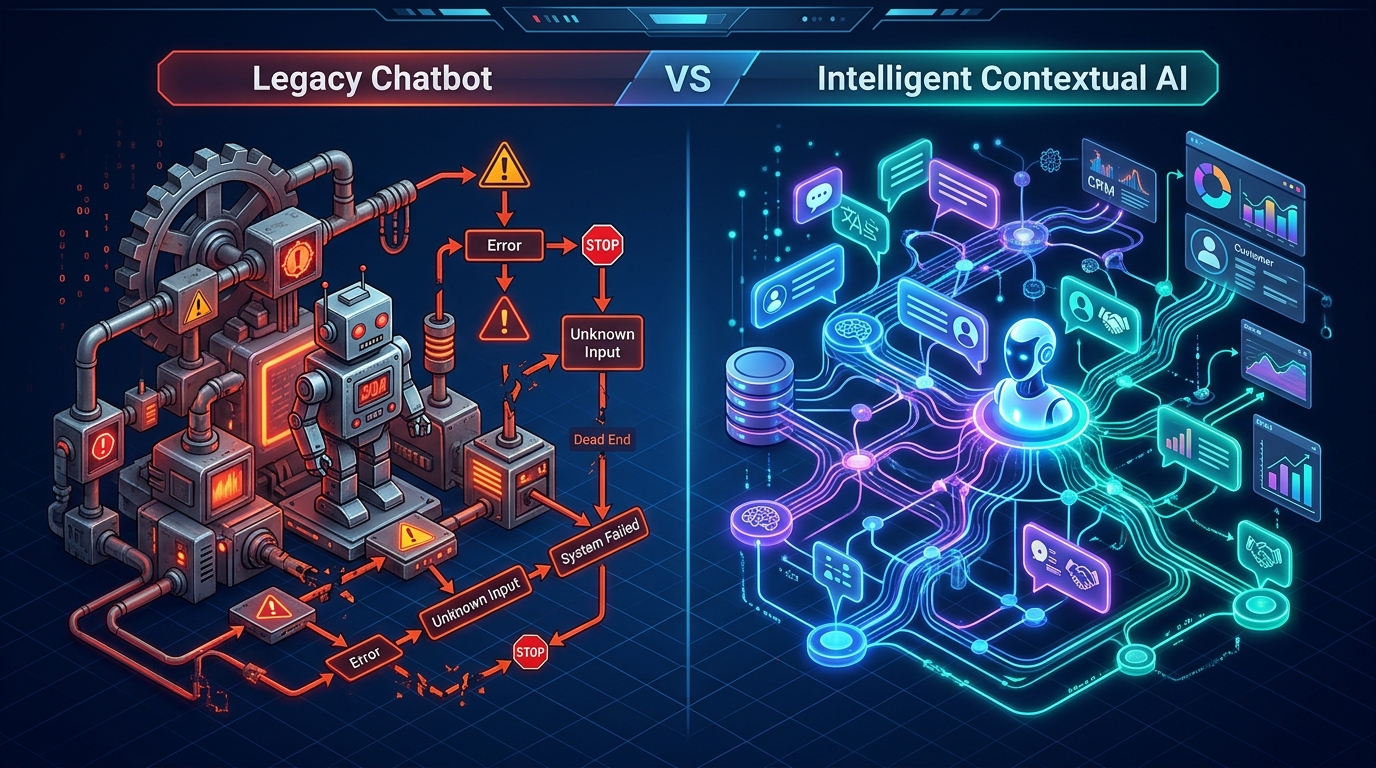
Legacy Rule-Based Bots vs. Modern Generative AI Agents
| Feature | Legacy Rule-Based Bots | Modern Contextual AI Agents |
|---|---|---|
| Language Understanding | Keyword matching only; breaks on typos or slang | Natural Language Processing (NLP); understands context and intent |
| Knowledge Source | Hardcoded static responses written by a developer | Retrieval-Augmented Generation (RAG) querying your actual docs |
| Conversational Flexibility | Rigid menu choices (If/Else logic) | Fluid, dynamic dialogues tailored to buyer nuance |
| Lead Qualification | Stiff form fills (“What is your email?”) | Natural discovery conversations that gather requirements organically |
| Human Escalation | Often trapped in loops without hand-off options | Smooth, context-aware hand-off with summary briefs for staff |
Modern AI agents do not rely on scripted guesswork. Instead, they leverage Large Language Models (LLMs) conditioned on your company’s proprietary data—your service catalogs, FAQs, onboarding guidelines, case studies, and scheduling links.
The 4-Stage Architecture: How Small Business AI Chatbots Work
Deploying an AI customer agent does not require an in-house engineering team. However, it does require a deliberate architecture to ensure accuracy, data privacy, and brand alignment.
Here is the four-stage framework behind high-performing conversational systems:
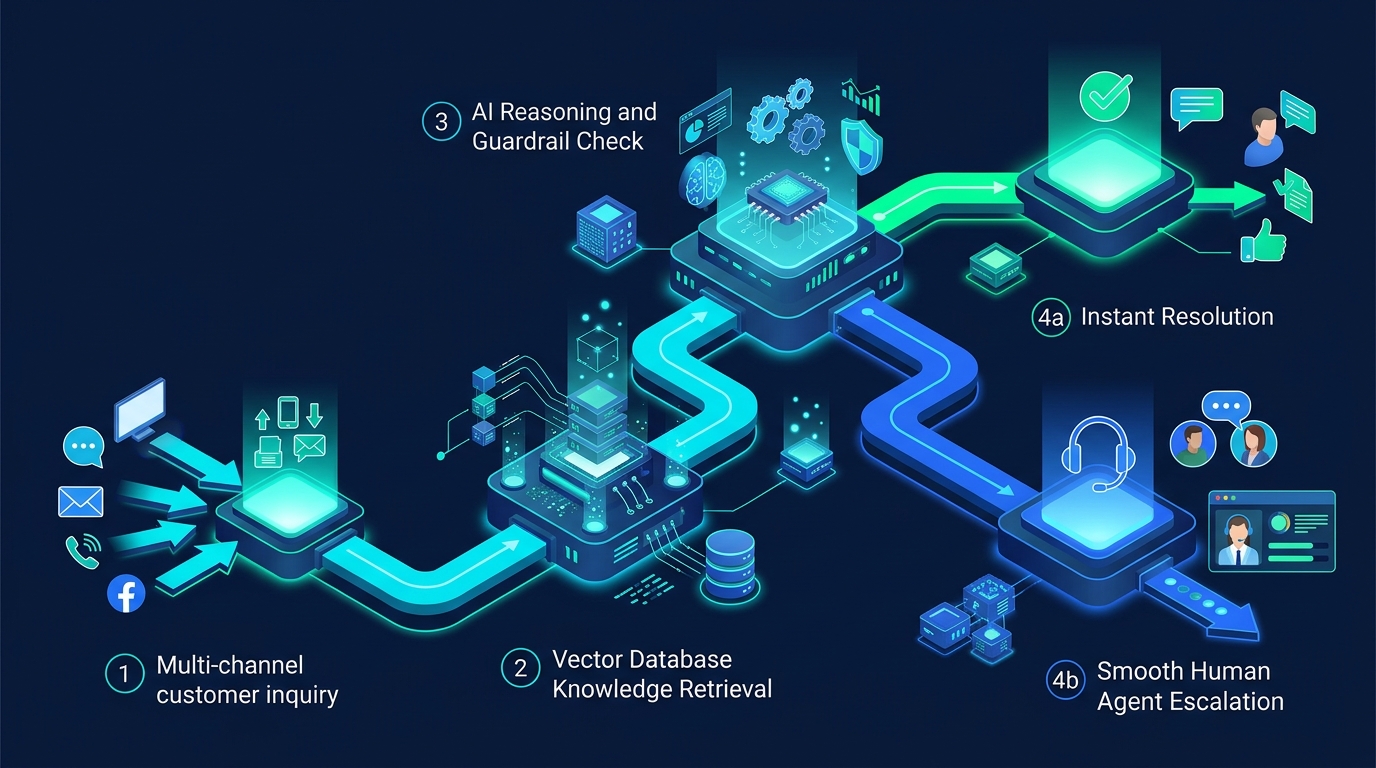
Stage 1: Multi-Channel Ingestion & Context Capture
Your customers do not interact with your business on a single isolated channel. A buyer might discover your brand through organic search on desktop, click an ad via mobile web, or message you directly through WhatsApp or Instagram.
Modern conversational AI systems deploy a unified API layer that captures incoming messages across:
- Website Embedded Chat: A lightweight, mobile-responsive widget on key conversion pages.
- Messaging Apps: Direct integrations with WhatsApp Business, SMS, and Facebook Messenger.
- Email Inboxes: Auto-drafting intelligent email replies for staff approval.
Stage 2: Knowledge Ingestion via Retrieval-Augmented Generation (RAG)
The most common fear among founders is: “What if the AI makes up answers about my pricing or services?”
This challenge is solved through Retrieval-Augmented Generation (RAG). Rather than letting the AI improvise from public internet data, RAG forces the model to search a private, vector database containing only your verified company assets:
- Service brochures and scope of work documents.
- Published case studies and client FAQs.
- Warranty policies, return conditions, and payment terms.
- Real-time availability calendars.
When a visitor asks, “Do you offer custom SEO audits for Shopify stores?”, the system searches your private knowledge base, extracts the exact relevant facts, and crafts an articulate, tailored response in seconds.
To see how similar autonomous data pipelines operate across your entire marketing stack, review our technical breakdown of agentic AI workflows and automated execution playbook.
Stage 3: Guardrail Engineering & Prompt Conditioning
As outlined in OpenAI’s official system prompting and guardrail documentation, production-grade conversational bots must be bound by strict negative constraints and persona instructions.
Core Guardrails Every Small Business Bot Needs:
- Strict Fallback Rules: If the required information is not found in your knowledge base, the bot must state: “I don’t have that specific detail on hand, but let me connect you with our specialist team.”
- Anti-Hallucination Boundaries: Explicit prohibition against quoting unverified discounts, promising impossible delivery dates, or discussing competitors.
- Tone Calibration: Defining the exact voice—professional, empathetic, concise, and approachable.
- Data Privacy Protection: Preventing the extraction of sensitive personal data or internal operating margins.
Stage 4: Dynamic Lead Qualification & Smooth Human Escalation
An automated conversation is only useful if it drives commercial results. The final stage of the architecture determines whether a query is resolved instantly or escalated to a human team member.
When an inquiry signals high buying intent—such as requesting a custom quote or expressing urgency—the chatbot initiates a structured lead qualification flow:
- Gathers the prospect’s name, business email, and primary challenge.
- Checks budget fit and timeline expectations naturally in conversation.
- Embeds an appointment booking calendar directly inside the chat window.
- Pushes the qualified lead into your CRM (HubSpot, Salesforce, or Google Sheets) and sends an instant Slack or SMS alert to your sales lead.
Connecting your conversational chatbot directly into high-intent B2B lead generation funnels ensures that zero high-value inquiries slip through the cracks during off-hours.
5 Practical Use Cases for Small Business Conversational AI
Small businesses across professional services, home services, healthcare, and e-commerce are using conversational AI to solve distinct operational bottlenecks:
1. 24/7 Inbound Lead Capture & Meeting Booking
Rather than forcing mobile users to fill out static 8-field contact forms, an AI assistant asks questions conversationally, answers preliminary questions, and schedules calendar appointments on the spot.
2. Instant First-Tier Customer Support
Resolving repetitive routine queries—order statuses, business hours, service locations, parking instructions, and return procedures—without burning staff hours.
3. Pre-Sales Product & Service Recommendations
Acting as a digital showroom concierge. For example, an accounting firm’s bot can ask three quick questions about business size and recommend the exact tax package best suited to the visitor.
4. Interactive Content Amplification
Helping website visitors navigate your knowledge base. When paired with an active AI content marketing framework for scaling small businesses, your chatbot can recommend specific guides, checklists, and case studies tailored to the user’s specific problem.
5. Multi-Language Customer Assistance
Small businesses operating in diverse metropolitan markets can instantly converse with prospects in Spanish, Telugu, Hindi, or French without hiring multilingual support staff.
Search Visibility & Technical Performance: Chatbots and SEO
A frequent question from marketing leaders is how on-site chat widgets impact search engine performance.
According to Google’s official guidance on helpful, people-first automation, user engagement signals and fast, helpful page experiences directly correlate with organic search visibility.
Furthermore, as highlighted in the Google Search Central ranking systems documentation, search systems evaluate whether users find satisfying, comprehensive answers to their intent.
When implemented properly, conversational AI improves key user metrics:
- Dwell Time: Visitors actively chatting with an intelligent assistant spend significantly more time engaging with your domain.
- Reduced Bounce Rates: Prospects who find immediate answers to their questions stay on site rather than bouncing back to search results.
- Conversion Rate Lift: Frictionless lead capture increases total conversion yield from existing organic traffic.
However, technical hygiene is essential. Ensure your chat widget scripts are deferred asynchronously so they never delay Core Web Vitals or block search crawler rendering. For an end-to-end framework on preserving crawlability, explore our comprehensive search engine optimization services and technical audit methodologies.
Furthermore, structuring your business documentation into clear question-and-answer pairs aligns directly with AEO and conversational search optimization strategies, ensuring your brand surfaces accurately across Google AI Overviews and answer engines.
30-Day Chatbot Implementation Roadmap for Lean Teams
You do not need months of complex development to launch a high-performing chatbot. Follow this 4-week roadmap:
Week 1: Knowledge Curation
- Gather your top 50 customer questions from sent emails, CRM notes, and support tickets.
- Document exact service scopes, pricing models, and booking policies into clean Markdown or PDF documents.
- Review your sales hand-off criteria: what makes a lead qualified to speak with an owner?
Week 2: Platform Selection & Prototype Training
- Choose a modern conversational platform supporting custom RAG (e.g., Voiceflow, Botpress, Intercom Fin, or custom LangChain agents).
- Upload your curated knowledge base and configure system guardrails.
- Run 25 mock conversations testing edge cases, tricky pricing questions, and off-topic prompts.
Week 3: Integration & Testing
- Integrate the bot with your calendar (Calendly, Google Calendar) and CRM.
- Set up automated notifications via email or Slack whenever a lead books a meeting.
- Test fallback escalation: verify that clicking “Speak with a Human” immediately pings available staff or collects contact details for morning follow-up.
Week 4: Live Staging & Iteration
- Embed the widget on high-traffic landing pages.
- Review chat transcripts daily for the first two weeks to identify unanswered questions.
- Update your knowledge base docs to close any informational gaps.
Practical Checklist for Small Business AI Chatbots
Before deploying your conversational agent live, verify every item on this quality checklist:
- ☑ Is the chatbot clearly identified as an automated AI assistant rather than pretending to be a real human?
- ☑ Does the bot draw answers exclusively from your verified business documentation?
- ☑ Are strict fallback rules enabled to prevent fabricated answers or unverified pricing quotes?
- ☑ Is calendar booking integrated directly into the conversational interface?
- ☑ Does the system alert human staff immediately when a high-value lead is identified?
- ☑ Can visitors easily request a human representative at any point in the conversation?
- ☑ Are customer chat transcripts securely stored in compliance with data privacy regulations?
- ☑ Does the widget script load asynchronously without slowing down page speed or Core Web Vitals?
- ☑ Have you tested the conversational experience across desktop, tablet, and mobile devices?
- ☑ Is there an active feedback loop to review chat logs and update knowledge docs weekly?
Frequently Asked Questions
Will an AI chatbot make my small business look impersonal?
Not when implemented thoughtfully. Customers appreciate fast, accurate answers far more than waiting 24 hours for a generic email reply. By combining instant automated responses for routine queries with smooth human escalation for complex consultations, you deliver a faster, more attentive customer experience.
What happens if the AI chatbot does not know the answer?
A properly configured bot will never guess or invent answers. When a query falls outside its verified knowledge base, the bot politely acknowledges the limitation, collects the prospect’s email or phone number, and routes the question directly to your team with full conversational context.
How much does it cost for a small business to run an AI chatbot?
Modern platforms offer small-business tiers starting between $30 and $100 per month for standard conversational volume. Compared to the lost revenue of even a single missed client inquiry or the cost of hiring full-time support staff, the return on investment is extraordinarily rapid.
Build an Intelligent Conversational Advantage with Ratnam Digital
In an era where customer expectations for instant answers have never been higher, small businesses that automate thoughtfully will capture the lion’s share of market demand.
By deploying an intelligent, custom-trained conversational agent, you can capture leads around the clock, streamline customer service, and empower your human team to focus on high-value client delivery.
Ready to build a custom conversational AI engine, integrate high-converting lead funnels, or elevate your B2B digital acquisition architecture?
Explore our full suite of enterprise-grade consulting solutions at Ratnam Digital and let us help you scale your business conversations effortlessly.
Let’s Grow Your Business with Ratnam Digital
Automate customer inquiries, qualify leads around the clock, and integrate intelligent conversational AI into your business workflow with Ratnam Digital.
Explore Conversational AI Request a Strategy & Growth Audit